)
As Australian startup Xefco aims to tackle the source of approximately 3 per cent of global carbon emissions in the textile dyeing and finishing industry, not to mention an immense wastewater impact, the tech startup has doubled its team size since a $10.5 million raise in April 2024.
In an industry that can use up to 200 litres of water per kilogram of fabric, Xefco co-founder Tom Hussey says his company's patented Ausora technology, involving a plasma coating solution for dyeing and finishing, uses no water and just a fraction of the energy required by traditional factory processes.
Xefco's Xreflex radiant barrier technology is already used by global fashion heavyweights such as Zara and The North Face to insulate clothing more efficiently, but the Ausora proposition is far more ambitious and has the potential for material disruption - literally - if it succeeds.
For a series on circular economy trailblazers we are running at Business News Australia, Hussey explains Xefco's next plans and how the company is tapping into a network of expertise left behind by Geelong's collapsed automotive manufacturing sector.
Like so many entrepreneurial stories Hussey's journey as a disruptor started in a garage, albeit someone else's.
He worked for Zhik founder Brian Connolly to help his company become a key international player in the world of specialised clothing and equipment for sailing and other water sports.
From experiments in that business and lessons learnt along the way, the pair laid the foundations for Xefco which they co-founded in 2018.
"Brian’s background was actually in high-tech hi-fi prior to founding Zhik, so he’s always had an innovative mindset which I of course share. When I joined, something that we both understood well when we got out into the supply chain and developed products was just how little innovation there was in the industry," Hussey says.
"The basic processes of how our clothes are made haven't really changed in centuries – the way that we make fabrics, the way that we dye fabrics, the way that we stitch them together, it's all the same old processes, and it just struck us how much opportunity was there.
"What also struck us was how big the environmental footprint is, particularly in textile production."
Discovering broader horizons for innovation
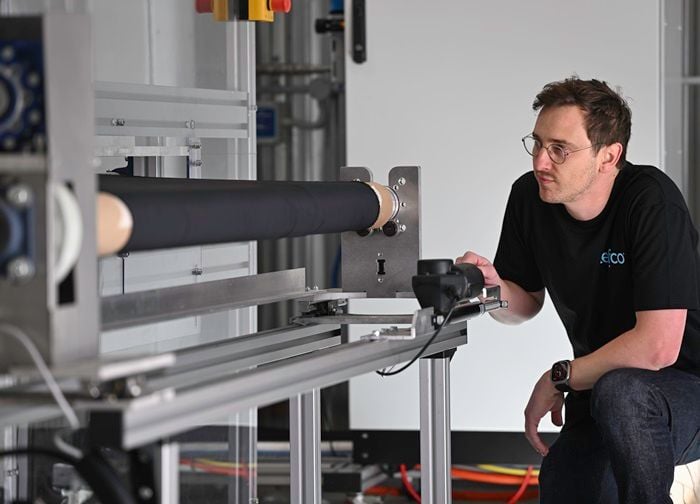
Their innovation at Zhik led to a collaboration around 2010 with Deakin University - a relationship that continues to this day. The university hosts a pilot plant for Xefco's Ausora technology and the development of a larger facility for manufacturing modular machines that Hussey expects will be up and running within six months, with plans to ship to factories internationally "not long after that".
"As we progressed with that research and started implementing a few things into Zhik products, it became clear that we’d actually developed solutions that had far bigger potential," he says.
"Several years later we got to a certain point of maturity with that research and we spun the technologies out into Xefco.
"The key premise was taking the knowledge and some of the IP that we’d already created and applying it with a different mindset of trying to tackle the big industrywide challenges that exist, and the main one there is dyeing and finishing."
Hussey says the textile industry as a whole makes up around 8 per cent of the world's carbon dioxide emissions, so over the past decade a lot of focus has been placed on waste and recycling - addressing fibre production and the end-of-life of textile products.
"Rightly so, these are really important problems," he says.
"It's actually the way that we put colour and functional properties onto the fabric – we call it dying and finishing in the industry – that has the biggest footprint of all the different steps.
"It's about 36 per cent of the carbon footprint of the whole supply chain – if you multiply that out, dyeing and finishing makes up about 3 per cent of global carbon emissions."
In addition to the vast amount of water that is also needed in the process, he notes the "huge" amount of dyestuffs, auxiliary chemicals and the finishing chemistry that have consequences for the environment, as well as workers in these operations.
"Only a bit of that ends up on the fabric. The rest of it is essentially rinsed off, so naturally that creates a massive waste water issue, and it's quite expensive and difficult to treat that wastewater, which ends up in rivers and streams," Hussey explains.
"It's been calculated that about 20 per cent of industrial water pollution comes from dyeing and finishing."
Eliminating toxic 'water factories'
Hussey elaborates further by clarifying that the large carbon footprint is due to the fact traditional processes uses so much water, which must be heated.
"Then you're drying the fabrics and doing this multiple times, using steam and heat which are generally produced by burning coal or gas, so therein lies your carbon challenge," he says.
"Picture a dyeing mill as essentially a big water factory – pipes going everywhere, you've got a coal or gas boiler out the back producing steam, everyone’s basically wearing singlets and shorts and gumboots and standing in puddles of water, and there are chemicals below the ground.
"It’s hot and steamy, there are all sorts of other vapours going around. It's pretty nasty place, and there are some nasty chemicals used in the processes."
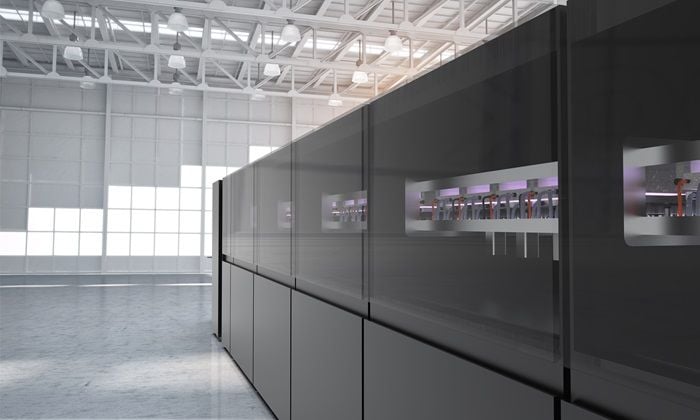
He says that in contrast, for the Ausora system you effectively have a "big box" where fabric goes in one end and comes out the other.
"Our inputs are electricity which, of course, can be sourced from renewable resources. You’ve got argon gas and then you've got a very small amount of the colourants, so pigments and some other precursor chemicals that are a fraction of what's used in conventional processes," he says.
"But there's no water, there's no wastewater discharge, and you can effectively put these units anywhere, and you don't need that big water factory so it's very clean.
"The people operating the equipment aren't exposed to that whole process and all the inputs and outputs, and it eliminates the potential for harmful outputs to be discharged into the local regions."
Hussey emphasises the technology also means processes can be moved to other locations, whereas current industries are centred around regions with abundant water supplies.
"By providing a process that allows you to move the processes elsewhere, you can position them and say more in line with your end garment assembly, and help to reduce some of the shipment of material around the place. This reduces wastage and obviously the footprint, and that increases production flexibility."
When asked about the potential of Ausora to reinvigorate Australian fashion industry manufacturing, he explains that it may have a place within part of the sector.
"It certainly can. There are other challenges to solve there, and obviously cost of labour and the actual manual practices to assemble the garments is a big one, but that can be overcome to a large extent if you've got other competitive advantages," he responds.
"The ability to produce in a responsive way, rather than in big productions that you need to stock, can be a way to enable onshoring and our technology certainly can allow that from a textile production point of view.
"The other thing where we're seeing a lot of a lot of drive from the manufacturing side is what they call 'near-shoring'. Moving garment production closer to the major centers and North Africa is a really interesting location because of its proximity to Europe and also ease of shipment to the US."
'170,000 machines' needed to address the problem
Bringing fashion industry manufacturing back to Australian soil might be a tough ask, but Hussey says the intention is absolutely to manufacture Ausora machines in Geelong for the long term.
"Everything's being designed to build and scale. We've got a really high quality team at the moment and work with a network of suppliers that predominantly exist from the former automotive industry in Geelong," the Xefco co-founder says.
"Geelong is an excellent place to be producing something like what we're doing because of that network."
The technology has attracted a "long list" of more than 70 brands and manufacturers that have approached Xefco about incorporating Ausora into their supply chains, and Hussey says it is "fundamental" to spend time with commercial partners to understand their needs and develop optimal maintenance solutions.
"There’s a large modular aspect so parts can be swapped out really quickly to keep them running on site," he says.
"Of course that all needs to then rely on maintenance and support network, so our roll-out and plans involve setting up teams in key regions to support the machines.
"Likely the first machines will go to Asia, and depending on the location we do have some teams already set up in some regions, but it’s essentially a focus for us in the coming year and months ahead.
Hussey says commercialisation will start with one or two machines, but the plan is then to scale up into "tens and then hundreds". Since April the team size has doubled to 30 staff as the group works towards these goals.
"By our calculations the world needs about 170,000 machines to solve the problem, so the sky's the limit in terms of the size of the market and the size of the problem."
Xefco may be a young startup but has the advantage of many years in the textile industry, with a facility in Taiwan that is a production base for Xreflex.
"People know us, we’ve developed relationships there and that certainly helps us a lot, as has having a product that people like and is out there," he says.
"Just as important is how much we’ve learnt from that commercialisation process and also being a textile producer ourselves in Taiwan. We've learnt a lot about the process that brands will go through to validate a technology and implement, and also the processes that exist in ongoing productions, so their quality control and order processing.
"That's played a big role in shaping our business model and basically our roll-up of Ausora."
)