)
Sydney-headquartered semiconductor company Syenta has raised $37 million (US$26 million) in Series A funding to commercialise its advanced chip packaging technology, with former Intel CEO Pat Gelsinger joining the board as part of the deal.
The round was co-led by US deep tech investor Playground Global, where Gelsinger is now a general partner, and the Australian Government's National Reconstruction Fund Corporation (NRFC).
The raise brings Syenta's total funding to $51.1 million (US$36.4 million).
NRFC's portion of the round is a $10.1 million preferred equity investment, while existing investors Blackbird VC, Investible, In-Q-Tel, SGInnovate, Jelix VC, OIF and Salus VC also participated.
Syenta was founded on research from the Australian National University and has developed a process called Localised Electrochemical Manufacturing (LEM), a semiconductor packaging technology the company says can reduce the number of process steps required by up to 40 per cent.
Advanced packaging - the process of connecting chips together inside a device - has become a critical bottleneck as artificial intelligence systems demand faster data transfer between processors.
Syenta’s LEM technology aims to improve the performance and scalability of chip systems, which the company says enables next generation AI and quantum computing.
The company currently employs 33 people in Australia and expects to create 25 new Australian jobs as it scales up. Syenta is also expanding to Arizona as part of its commercialisation strategy.
Gelsinger, who led Intel from 2021 to 2024, says the technology addresses a fundamental constraint in AI hardware development.
“This is a new way of building high-performance systems at unprecedented scale and power, particularly as AI workloads continue to grow,” he says.
“AI’s next scaling challenge isn’t just compute - it’s how chips connect. Syenta is addressing a fundamental constraint in advanced packaging, and that has the potential to reshape how future systems are built and scaled.”
Syenta co-founder and CEO Dr Jekaterina Viktorova says the funding, including backing from NRFC, will allow the company to keep its research and development base in Australia while pursuing global customers.
“Syenta was founded at the Australian National University and our partnership with the NRFC ensures that all first-of-a-kind research and development will stay in Australia," she says.
"Our mission is to enable higher performance and more scalable AI systems through our innovative technology for advanced chip packaging that improves the performance of semiconductor chip systems.
"Having the National Reconstruction Fund on board as an investor means that we will be able to grow the company globally while keeping our roots in Australia.”
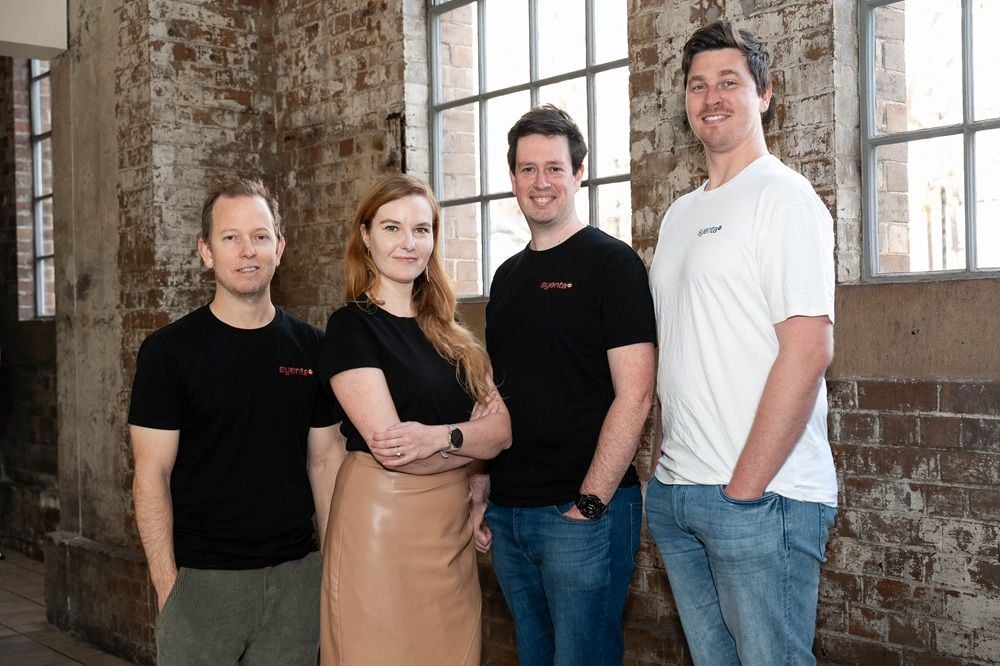
Viktorova sees Syenta ultimately growing into a pillar of the local manufacturing industry.
"We anticipate that our partnership with the NRFC will help us to open the doors we need to help anchor an advanced semiconductor manufacturing sector in Australia,” she says.
NRFC chief investment officer Dr Mary Manning says the investment aligns with the fund's mandate to support sovereign manufacturing capability.
“Syenta’s world-leading technology is designed to unlock the next generation of AI and quantum computing, and we are proud to be investing in this early-stage Australian technology and manufacturing company,” she says.
“Semiconductor chips are strategic assets and investing in Syenta will commercialise doctoral research that came out of the Australian National University, keep Syenta’s valuable intellectual property in Australia and help establish sovereign advanced semiconductor manufacturing capabilities in Australia.
“Syenta’s technology also has the potential to generate less waste and use significantly less energy than conventional semiconductor manufacturing processes, and NRFC investment will enable Syenta to embed low-carbon and circular practices in its technology as it scales.”
NRFC has $15 billion to invest across priority sectors of the Australian economy.
)