)
The ability to turn air into water is not new, but University of Newcastle researchers have just unveiled technology they say is able to achieve this at a lower cost and using less energy while delivering enough water to meet the needs of remote communities.
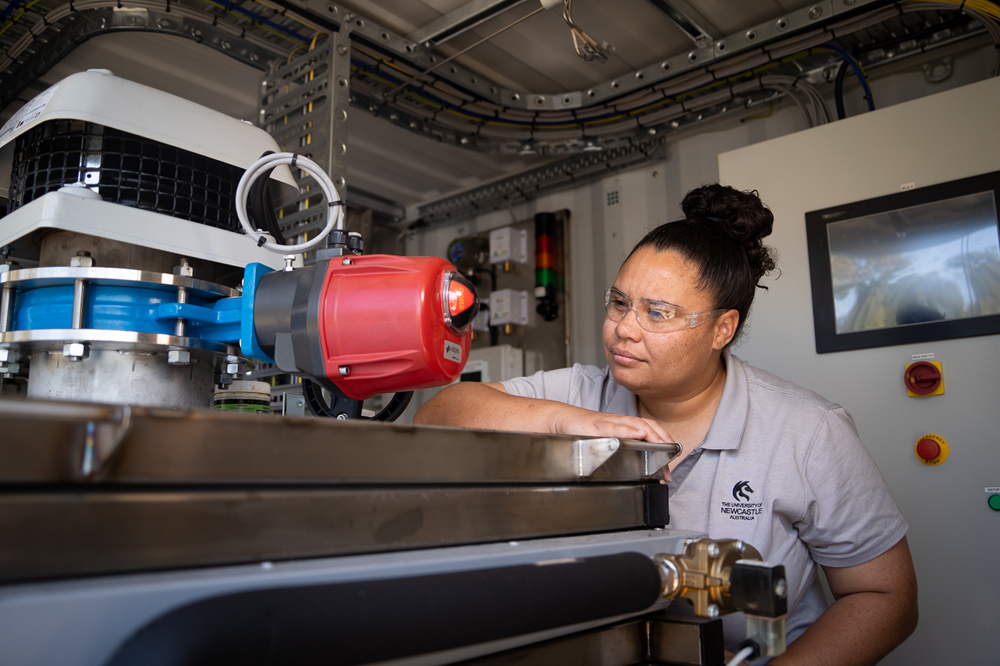
The researchers have officially unveiled their Hydro Harvester technology that is capable of harvesting up to 1000 litres of drinkable water per day by absorbing water from the atmosphere.
Backed by grants from the federal Future Drought Fund, the technology uses solar energy or waste heat to produce hot and humid air which is then cooled using ambient air as a heat sink to extract water for drinking or irrigation.
The process differs from conventional technology which primarily cools air to extract water from the atmosphere, a system that often requires more energy.
The University of Newcastle researchers, led by Laureate Professor Behdad Moghtaderi, have managed to scale up their original pilot project producing 20 litres of drinkable water a day to a modular system that produces 1,000 litres a day.
The researchers say Hydro Harvester is edging closer to commercialisation with capacity to produce enough drinking water for a small rural community of up to 400 people.
“By using solar thermal energy or waste heat, the Hydro Harvester has a lower electrical demand and lower average cost of water per litre than commercial AWGs (atmospheric water generators),” says Moghtaderi, a chemical engineer and director of the university’s Centre for Innovative Energy Technologies.
“Our technology is designed to operate independent of the ambient temperature and humidity, so it’s suitable in virtually any environmental condition, and is cheaper to run.
“The levelised cost of the atmospheric water extraction using the Hydro Harvester is substantially lower than that of conventional refrigeration-based systems.”
Moghtaderi says the team is looking forward to trialling Hydro Harvester in remote communities later this year.
The university researchers have been working on the Hydro Harvester technology since 2018, initially with a view to providing a reliable source of drinking water for drought-affected communities.
However, Moghtaderi says the system can also provide emergency water supply for livestock which could help pastoralists avoid completely destocking during drought while also facilitate faster economic recovery when the rain returns.
“Or it could be used to temporarily supply communities when water is disconnected during repairs of leaking infrastructure,” he says.
“There’s also potential to provide emergency water supply during disasters.
“We look forward to connecting with a range of potential partners to explore how our communities can benefit from this technology.”
Moghtaderi leads several critical greenhouse gas abatement programs at the University of Newcastle including a collaboration with German oil and commodities trading company ASCON Group to achieve negative emissions in the production of green steel and green chemicals.
Recognised as a world leader in hydrogen ammonia safety, Moghtaderi and his research team announced in April a partnership with Singapore’s Agency for Science, Technology and Research that aims to quantify and mitigate risk from large-scale hydrogen ammonia storage in Singapore.
)