)
While Black Friday is a major contributor to landfill waste globally, a Brisbane-based outdoor goods brand has proven that genuine environmental credentials can go a long way for both sales and positive environmental impacts during the annual sale event.
Nakie co-founder Dean Leibbrandt tells Business News Australia the company - known for its hammocks, beach towels and puffer blankets made from recycled materials - not only lifted Black Friday sales 40 per cent year-on-year in 2025, but also recycled six million plastic bottles and planted close to 700,000 trees.
"It was the first time we've ever hyped a sale. Normally we just send an email and SMS letting customers know we're live, but this time we locked the website for two days and spent money on hype telling customers that the sale was coming," Dean explains.
"On day one we ended up selling one product every 1.9 seconds for a full 24-hour period.
"In terms of impact, that single day we saved 17 plastic bottles from entering waterways every second, and we ended up planting two trees every second over the 24 hours."
Nakie's range of products have secured a loyal following, also inking branding partnership deals with the NRL and more recently the AFL, Cricket Australia and Minecraft. Its founders strive for the usual benchmarks in consumer-facing goods with an emphasis on quality and design, but their vision always comes back to sustainability.
Dean, his wife Tegan Leibbrandt and brother Jaryd Leibbrandt wanted to home in on this ethos in their marketing a couple of years ago while also backing up their philosophy with very high B-Corp scores, contradicting marketers who advised otherwise.
"No one cares" was the response the Nakie team received from a marketing agency when they pitched copy around the business fundamentals of making products from recycled bottles, and planting four trees for every product sold.
"They kept pushing back, changing the copy, saying your message doesn’t sell – 'we just want to say how amazing the hammock is, so don't worry about the sustainability piece'," recalls Dean, who alongside his co-founders won the 2025 Brisbane Young Entrepreneur Award - Sustainability & Social Responsibility.
"We thought that was rubbish. We ended up moving to another agency and had similar feedback, so we thought let's take it all in-house. We ended up training our own marketing flywheel within the business including video editors, videographers and media buyers.
"If you look at any of our videos, we call out how many plastic bottles it takes to make the product, how many trees we plant, and we show where the trees are being planted."
Correlation does not always mean causation however, and it was never a given that Nakie's sales growth could be directly attributable to its sustainability-focused marketing; that is, until post-purchase surveys showed that it definitely was.
Initial survey results revealed the top motivation to purchase was sustainability-related in 80 per cent of responses, but Dean was concerned this might be influenced by a sense of obligation on the part of consumers or the way the questions were framed.
"Maybe people are just feeling like they have to click that because they're buying from us," he asked himself at the time.
"Then we swapped the questions around, and it stayed the same. Then we tried not giving them responses - just a blank box where they can manually write the reason why they purchased, and again, 80 per cent said it was because we're planting trees, what the products are made from, or what we're doing for the planet," he says.
"People can say whatever they want, but the numbers don’t lie."
From scuba diving to the birth of Nakie
While Dean worked in fast-moving consumer goods (FMCG) with the likes of Kraft Foods and Johnson & Johnson, his brother Jaryd was living the expat life around the world, and alongside Tegan they made a point of spending two to three weeks together each year on annual leave in a variety of destinations.
"Everywhere we ended up, we'd always go scuba diving," says Dean.
"In the later years he [Jaryd] was spending a fair bit of time in Asia, and we'd go scuba diving there. Every time we'd come up, instead of talking about the manta rays or the whale sharks, we'd jump back on the boat and talk about the amount of plastic - the straws, the little bits of plastic. Sometimes you'd get plastic stuck to your skin, it's just absolutely ridiculous."
When Jaryd came back to Australia, the trio would always be outdoors on the weekends, whether it was camping, fishing, boating or water skiing. Together, they contemplated how they could turn their love for these activities, and for the planet, and bring them together.
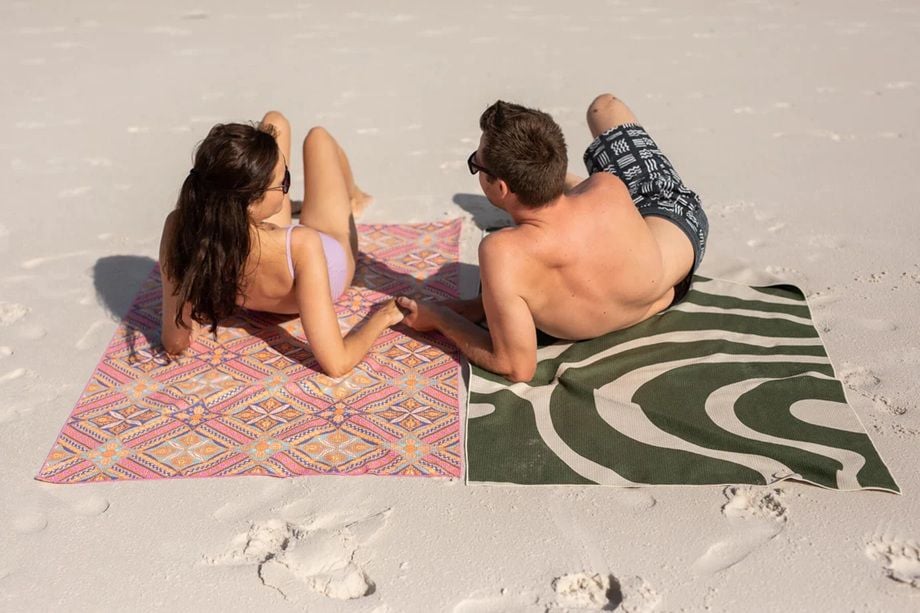
It was Tegan, who while growing up had spent much of her school holidays camping, that came up with the idea for a hammock made from recycled materials.
Some manufacturers told the founders it wouldn't be possible to do this, but they knew of US companies that were applying this principle to leggings and tights, which are made of similar types of materials such as nylons and polyesters.
"We thought if it’s possible there then it has to be possible to make it out of for a hammock, and eventually we managed to get a few different prototypes back and forth until eventually we had our final product made from 37 post-consumer plastic bottles," Dean says
"That probably took about nine months. It was the first product and it's definitely the number one seller.
"It's a little compact hammock that weighs less than a kilo. You can put it under the seat of your car and it holds 225kg. It's obviously super seasonal so most of our hammock sales are coming in the summer, so we thought about how we could diversify and launched a puffer blanket, then beach towels, picnic blankets, and now we've gone into backpacks."
'Planting people out of poverty' and how Nakie took reforestation into its own hands
From the beginning Nakie was planting trees for every sale, utilising the services of an international company that gave out badges for companies that had reached the threshhold of planting 100,000 trees, which in the statup's early years seemed seemed very ambitious.
"Back then our goal was 'imagine if we could plant 100,000 trees just ever in the whole lifetime of the business'. That was quite a massive goal as at the beginning we were planting 500-1,000 trees a month," Dean says.
"We thought 100,000 trees was a massive stretch, but now we can plant double that in one day."
He says Nakie loved what the global tree planting partner was doing, but when the company hit 500,000 trees planted and struggled to gain permission to actually visit their plantings, the decision was taken to take the matter into their own hands.
Dean and Jaryd were born in South Africa where they had seen poverty firsthand. Whilst they originally thought they could plant trees in Australia, and indeed have, one key constraint is the cost of labour. In contrast, in less developed countries there is the possibility to plant trees and contribute to more significant employment generation.
"We ended up reaching out to a few different people, and managed to get a meeting in Kenya with the foreign affairs minister and the environmental minister," he says.
"Jaryd and myself jumped on an airplane, flew in, booked a meeting, went to parliament, sat down with both of them and told them our story - everything we want to try and achieve, and the run rates on how many trees we planting."
"They gave us land over there in Mombasa and we signed a 550-hectare lease and we can plant five million trees on that plot."
With that leased signed, Nakie can plant all the trees itself, and utilises the services of a company called Veritree that verifies every single tree that gets planted, all coded through the blockchain and GPS-tracked.
"What we’re doing on our site is we’ve committed that we'll plant one million trees a year for five years. We also have a five-year plan for after that so we can employ the locals for five more years to make sure they maintain the trees and actually they survive in the long term.
"In terms of full-timers we have about 30 getting all the nurseries set up, and in the planting season it can go up to a couple of hundred people.
"For us we call it 'planting people out of poverty' – we’re going to places like Kenya, planting trees and getting communities that were poverty stricken that are planting trees, making money. One of the biggest reasons why we want to keep the business long-term is the impact."
Another important component of Nakie's Kenyan tree planting program is its emphasis on promoting riverine health and biodiversity by developing mangroves, which can sequester significantly more carbon dioxide per hectare than terrestrial forests.
"Normally on a site it’s just sand when we get there – when you start planting mangroves, they bring like a heap of mud, and then the mud brings fish," Dean says.
"In the community now there’s so many more jobs being created of people getting crabs, more fish – it’s helping the mangrove ecosystem but then also creating even more jobs that are not directly from us."
Since the lease was signed in Kenya in 2023, 2.7 million mangrove trees were planted until the end of October this year, and Dean expects that figure has now passed the three million mark.
How B Corp adds weight to green claims
With the amount of greenwashing that exists, the founders of Nakie have pulled out all stops to deliver on their mission with tangible results and accreditations. Part of that has been achieving B Corp certification.
"It evaluates your whole business, from your community and how you treat your employees through to the environment, taking about a year to 18 months to get B Corp certified," Dean says.
"A normal business would score 50 points on their system. To be B Corp certified you need to score 80, and our first attempt at getting registered we ended up scoring 111.2.
"For context, Patagonia’s first score was 104-105. Our result came from everything we're doing, like the packaging in how we ship all our parcels to customers - we use compostable mailers which are all made from corn starch, so you can literally rip the label off and put it in the compost bin.
"Then it's the products and how they’re being made. We have our own warehouse, and we thought how do we take this a step further?"
The answer was to go off-grid, both in terms of electricity and council water.
"We've built a 1300sqm warehouse, and on the roof we’ve got 30 kilowatts worth of solar. We’ve got 15 kilowatts worth of batteries that run the whole warehouse, during the day, during the night," he says.
"Then for water we’ve got two 23,500-litre water tanks that then run through a seven-phase osmosis machine, so we’ve got drinking water in the warehouse, as well as being able to flush the toilets and everything else."
As the company grows in stature, signing new deals, developing new products, and seeking out more opportunities to make a better impact on the environment and the planet, Dean is also pleased with Nakie's latest B Corp recertification score.
"At the moment we’re ranked number one in the southern hemisphere and we ranked third in the entire world within our category. We ended up scoring 128.3 and I think Patagonia's second score ever was 112 - that just puts it into perspective."
)