)
Fleet Space Technologies, an Adelaide-based space exploration company, has firmed up its interests in the search for natural resource following the acquisition of HiSeis, a Perth mining technology company that specialises in hard rock seismic solutions to target the discovery of orebodies.
The acquisition follows the company’s $150 million Series D capital raise in December and comes in tandem with plans by Fleet Space to build a new global headquarters and “hyper factory” for next-gen space and climate technologies at Adelaide Airport.
Fleet Space sees the new facility positioning South Australia at the forefront of global AI innovation used to discover energy-transition minerals in a faster and more sustainable way.
Following the acquisition, HiSeis will be integrated into Fleet Space’s end-to-end exploration platform, ExoSphere, which is said to be helping drive the “next wave of new discoveries for Earth’s clean energy future’.
“Fleet Space’s acquisition of HiSeis marks a transformative leap into the future of data-driven exploration,” says Flavia Tata Nardini, the CEO and co-founder of Fleet Space Technologies.
“To unlock the potential of real-time exploration and AI, we must consolidate, standardise and integrate high-quality datasets to maximise the predictive capabilities of frontier AI systems.
“By combining Fleet Space’s vertically integrated exploration platform with HiSeis’ seismic exploration solutions and imaging expertise, we are taking a vital step to generate exabytes of high-quality exploration data needed to unlock faster exploration outcomes and enhance shareholder value for the global mining industry.”
HiSeis offers high-resolution subsurface imaging using seismic energy to aid in the identification of mineral deposits. By employing state-of-the-art processing tools, the company can create a coherent image of the reflected energy to interpret the metre-scale complexity of mineral deposits and assist with drill-targeting selection.
Fleet Space says that by integrating this technology into its ExoSphere platform, which uses Fleet Space’s satellite network, patented smart sensors and proprietary multimodal AI models, the hard rock seismic data produced by HiSeis can be rapidly processed, providing multiple benefits to the resources industry, including minimising environmental impact at scale.
"With this acquisition, Fleet Space is poised to radically transform seismic imaging on a global scale,” says Fleet Space’s chief technology and product officer Dr Hemant Chaurasia.
“By integrating HiSeis’ innovative seismic solutions with our state-of-the-art, real-time data processing and transmission system ExoSphere, we will greatly expand scalability while further reducing the time and environmental impact associated with acquiring high-resolution active seismic data.
“Downstream, this will enable more adaptive field operations and accelerate decision-making with faster access to actionable data-rich insights while on campaign.”
Meanwhile, Fleet Space, which doubled its valuation to $800 million following the latest Series D capital raising, sees the acquisition of HiSeis as an important part of its plan to expand into new headquarters at Adelaide Airport.
The company says the new 5,300sqm facility will enable Fleet Space to accelerate the production of its space technologies and scale its ExoSphere division.
The new headquarters will feature advanced manufacturing and data centre technologies, enabling production capacity for thousands of Fleet Space’s patented smart sensors and hundreds of satellites annually.
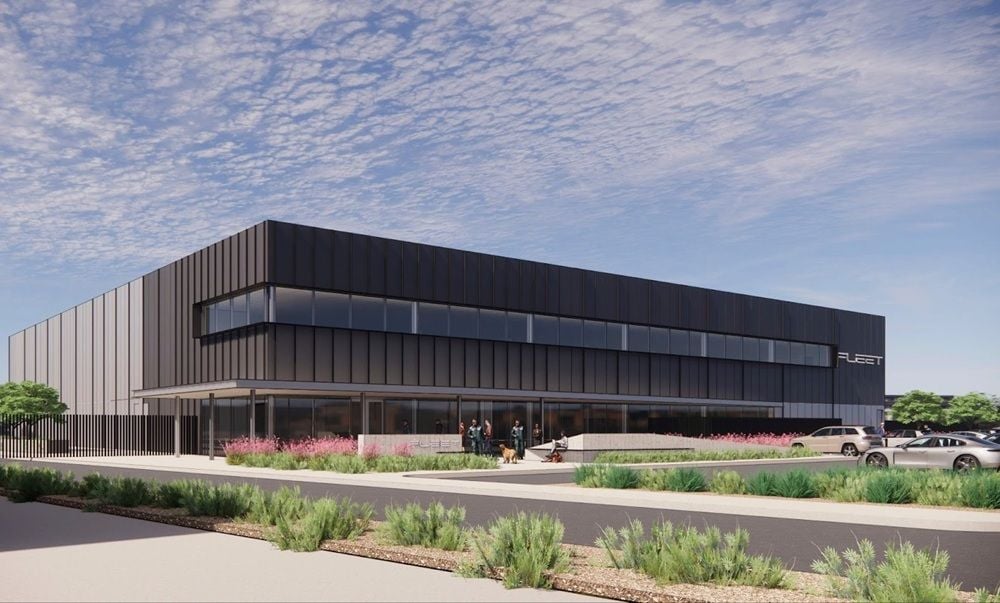
The facility is also expected to accommodate hundreds of new jobs in South Australia, while also establishing the basis for Fleet Space’s exploration-focused AI supercomputer ExoCore.
Fleet Space says its global headquarters (GHQ) and hyper factory will deliver a hybrid manufacturing model for frontier technologies needed to achieve decarbonisation and net-zero targets.
The facility will house the company’s research and development labs, 3D printing technologies, data centre infrastructure, and central operations for the company’s satellite network in low-Earth orbit.
The new headquarters will also host central operations for ExoSphere, which is currently used by more than 40 companies globally, including Rio Tinto, Barrick, Gold Fields and Ma’aden to survey for energy transition minerals across five continents.
Adding to its collaborations in the resources sector, Fleet Space last month announced that it had partnered with natural hydrogen explorer Koloma to accelerate the US company’s plans to find scalable resources of the green-energy gas globally.
“GHQ is the forerunner for the next-gen manufacturing model needed to unlock and scale the space, climate, and AI-powered technologies our planet needs to get back on track for net-zero,” says Fleet Space’s chief exploration officer Matt Pearson.
“The powerful new capabilities emerging from a deep convergence of frontier technologies in space, climate, and AI are foundational to achieving our clean energy future.
“Getting there requires a vertically integrated manufacturing model optimised for the rapid advances in these technologies.
“GHQ is Fleet Space’s bold first step, and we hope industries around the world pursue similar models to support the innovation needed for our decarbonised future.”
The dual announcement by Fleet Space today has also coincided with the company’s 10-year anniversary.
“Today marks a significant leap into the future for Fleet Space and Australian innovation, as we continue our mission to build revolutionary frontier technologies that address the dual challenges of climate change and space exploration, from the heart of South Australia,” says Tata Nardini.
“What began as a bold vision ten years ago when we founded Fleet Space has grown into a global force transforming the future of exploration on Earth and beyond.
“The tremendous evolution of Australia’s innovation ecosystem charts a clear path for Australia’s ascendancy in space, climate technologies, and artificial intelligence.
“With our new GHQ at Adelaide Airport, we’re strategically positioned to continue our exponential growth and development of cutting-edge technologies, paving the way for a more sustainable future on Earth, while furthering humanity’s exploration of new worlds.”
)