)
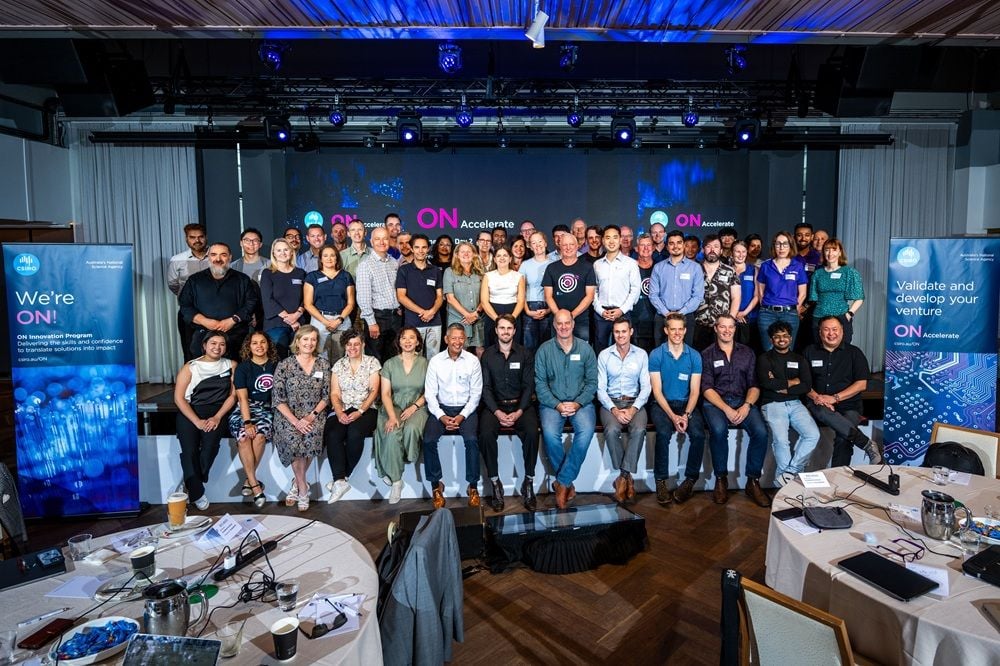
From pioneering clean ammonia production to developing devices that improve outcomes for knee surgery patients, 11 ambitious startups aiming to transform industries such as medicine, health and biotechnology have been selected to take part in the CSIRO’s ON Accelerate program.
Now in its ninth iteration, the three-month accelerator offers entrepreneurial researchers the tools, resources, industry experts and investors needed to help translate innovative technology into commercial successes in Australia and beyond.
This year’s cohort joins the ranks of alumni who have collectively created 81 new companies and secured more than $360 million in commercialisation grants.
Speaking with Business News Australia, Facet Amtech co-founder James Bradley explained how the Newcastle-based startup is developing a novel process that can create clean ammonia using just air, water and a catalyst – a discovery uncovered by his co-founder Peter Richardson.
“We've discovered a new catalyst which is the material that synthesises the ammonia from the feedstock gases. Our catalyst can operate under completely different conditions than a normal Haber-Bosch catalyst would, which allows us to do some things that hitherto have been impossible," Bradley explained.
"We can directly use water as a hydrogen source, whereas if you use water over all other catalysts, that will just destroy them. It's allowing us to rethink the way ammonia is produced.
“It came out of the University of Newcastle from a bunch of lab experiments. We've now got a small plant that has proven that we can make ammonia just using air and water. So now the next steps on the technology front is trying to work out how do we can turn that up and make lots more ammonia.”
While the vast majority of the world’s ammonia use relates to agriculture, making up about 70 per cent according to the International Energy Agency, Bradley believes its application can be expanded to become a clean fuel for shipping and industrial power generation.
“If we can make clean ammonia, then we have a whole new market as a renewable fuel because you can burn ammonia and have no carbon output. That's the exciting part - this potential emerging market of clean fuels," he said.
"Now it's not a clean fuel for everything, so it's mainly going to be used in large shipping - so boats, trains, fixed plant power supplies. It can be used - but is a bit more difficult - to use on vehicles, etc.”
Given ammonia’s higher volumetric energy density compared to hydrogen and its easier transportability, Facet Amtech argues that it presents a compelling alternative for decarbonising sectors that rely on high-energy fuels.
While in the early development stages, Bradley is hopeful the proprietary technology, which received backing from the CSIRO’s deep tech innovation fund Main Sequence Ventures for an undisclosed amount, will eventually be able to change the way ammonia is used forever.
“The end state is we have a new piece of technology that is used globally to make ammonia because it hopefully will be far more efficient and less energy intensive than what's been done around the world now," he said.
"Ammonia is a very tight commodity, so there are not fun places to play with ammonia - you're either cheaper and better or you're not. We certainly have the potential to be able to do that and just got to prove it out now."
Another startup under the CSIRO’s wing is Canberra-based orthopaedic technology company Viortec, which is about to trial its SmartClamp device on 40 knee surgeries in partnership with medical equipment giant Medacta.
The device, which was designed by a team of two orthopaedic surgeons and two engineers, aims to give surgeons a better understanding of how much force to apply when aligning and securing joint implants to improve patient outcomes.
“When some people come out of having a total knee replacement, they can say that their knee feels loose or it can feel too tight, and that is all around how the ligaments have been balanced around the new knee, because the ligaments are what hold the knee from down the side, medial, lateral," said Viortec co-founder and CEO Dr Catherine Galvin.
"This is where the surgeon’s expertise is just incredible because they check this ligament balancing pretty much bespoke.
“The first thing we wanted to do was measure the force that they are applying and understand what force relates to a ligament that is well balanced. Basically, we’re getting data on something that has never been measured. It’s a really important part of the surgery, and it's a really important part of patient outcomes.”
When asked about what she hoped the ON accelerator would offer, Galvin said it has already helped her and co-founder Dr Tom Ward get in the “right rooms” and “sitting at the right tables”.
“The ON program has actually enabled us to talk to people so we could really speed up our commercialisation plans and our market strategy," Galvin explained.
"These weren't things that I was strong on before, and especially for the SmartClamp - learning how to be attractive to investors, what information are they looking for and what questions we ask so we make sure we find the right investors.
“You're surrounded by innovators, potential investors and mentors, and everybody wants to see you succeed. It's brilliant.”
Bradley adds that having access to industry experts who have a strong understanding of deep tech research projects has been invaluable in navigating the complexities of bringing their innovation to market.
“What ON is excellent at is building an Australia-wide network of really clever people who have done the commercialisation of deep tech research…it's often a lot slower, more costly, more difficult, higher risk,” Bradley said.
“They've been around for a while now, so they've got a really good support network around them and within the program targeted directly at that problem.”
Executive Director of Future Industries Dr Jen Taylor highlighted the ON program’s pivotal role in driving Australian innovation forward.
“We’re constantly amazed by the ground-breaking solutions from the ON Accelerate teams, and this cohort is an inspiring reflection of Australia’s burgeoning strength in biotech and healthcare innovation,” Taylor said.
“We’re incredibly proud to support their journey. This cohort is very impressive, but we know that venture pathways come with plenty of challenges. Connecting with expertise and support can be the difference in unlocking the success pathways that ensure their ideas evolve into real-world solutions, products and companies that will truly improve lives.
“By fuelling Australia’s technology ecosystem with bright minds, we empower researchers to see their work evolve from the lab to reality, creating a brighter and healthier future for all.”
Meet the 2025 ON Accelerate cohort:
3DCeraFlex, from James Cook University, has developed patented technology for 3D printing flexible ceramic solutions, revolutionising high-temperature, defence, and energy applications. Currently working with AIMS to develop ceramic solutions for reef collaboration.
Ability Optics, an SME spun out of the Australian National University, focused on accelerating drug development. It has patented imaging hardware that enables faster and more cost-effective cell and tissue microscopy techniques, quickening the time-to-market for new personalised medicines.
Amorfoil, from CSIRO developed a patented planar flow casting process to create cost-competitive, efficient materials for grid distribution and electric vehicles.
Elemental Therapeutics, The University of Melbourne, restoring the efficacy of antibiotics against drug-resistant infections through the development of PBT2, a small molecule therapeutic for community-acquired bacterial pneumonia.
Enhanced Analgesics, from the University of Sydney, is addressing the global chronic pain crisis by developing a non-opioid drug that provides 24-28 hours of effective pain relief, offering a sustainable breakthrough alternative for millions suffering.
Facet Amtech, an SME licensing technology from the University of Newcastle, is revolutionising ammonia production with a breakthrough technology that improves energy efficiency, reducing the need for carbon-intensive natural gas.
I-VADE, from Edith Cowan University and in partnership with Alpha Immersion, is addressing rising violence in healthcare with an innovative VR-based aggression de-escalation training solution, improving overall staff and patient care.
ProSeek Bio, a startup commercialising technology from QIMR Berghofer, is closing the gender health gap with next-gen diagnostics, starting with ovarian cancer blood tests, aiming to revolutionise ovarian cancer diagnosis for women worldwide.
Epiblox, from the University of South Australia, is developing a breakthrough treatment for severe childhood epilepsy. Its lead drug candidate holds life-changing potential and strong commercial viability.
Topicure, from RMIT University, is developing gel-based formulations to improve the delivery of active compounds through the skin, reducing side effects and increasing compliance for patients.
Viortec, an SME spun out of the Australian National University, is developing innovative devices for hip and knee replacement surgeries, enhancing surgical precision, supporting surgeons and improving patient outcomes.
)