)
Australia has emerged as the most sought-after country for United Kingdom businesses looking to expand internationally, according to a new global report, although the nation's overall business conditions lag well behind top-ranked Ireland.
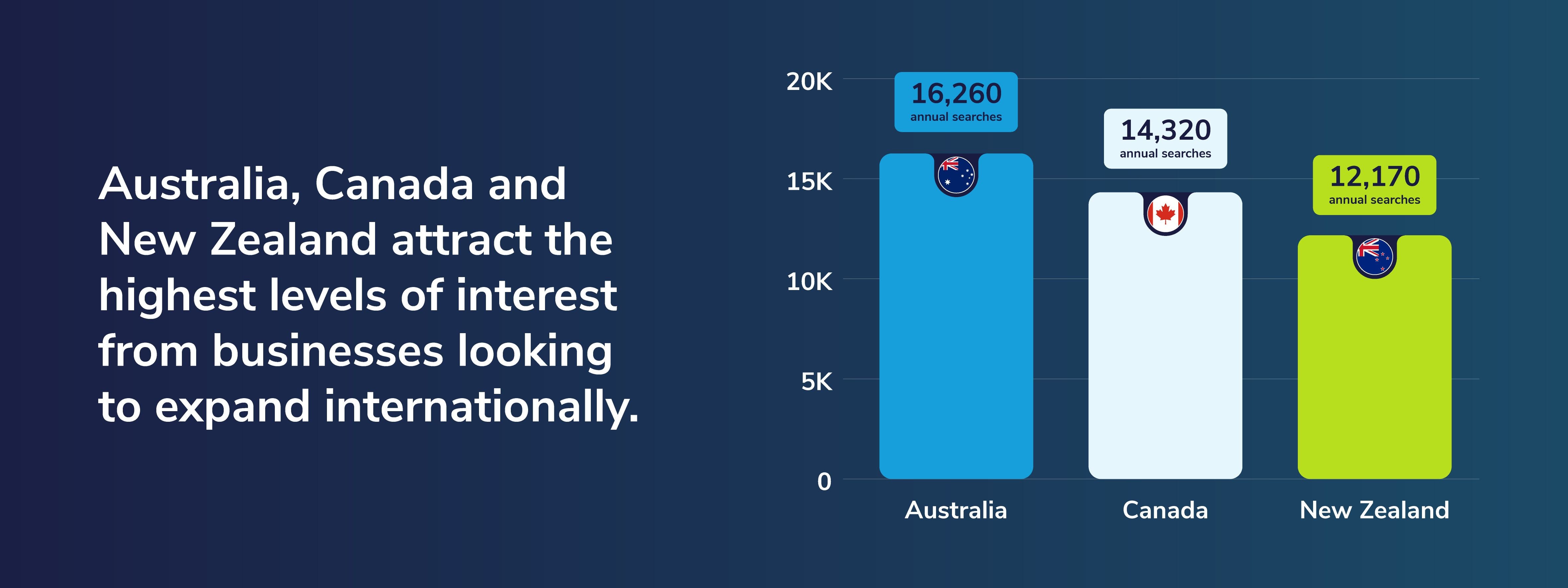
The Global Business Expansion Report from cross-cultural training firm Country Navigator found "Starting a Business in Australia" attracts 16,260 annual Google searches - more than four times the global average of 3,594 and ahead of Canada (14,320) and New Zealand (12,170) in second and third place respectively.
The findings land as a separate study from HSBC, surveying 2,700 businesses with turnover between US$50 million and US$2 billion across 18 markets, found 77 per cent of companies plan to expand overseas in the next two years, with UK businesses among the most expansion-minded at 89 per cent.
However, the Country Navigator report draws a sharp distinction between popularity and suitability.
Despite topping the search rankings, Australia placed just eighth overall for business expansion conditions with a score of 5.84 out of 10, weighed down by a 30 per cent corporate tax rate, GDP growth of 1.4 per cent and an unemployment rate of 4.1 per cent.
Ireland claimed the top spot overall with a score of 7.67, buoyed by a 12.5 per cent corporate tax rate, GDP growth of 2.6 per cent and a political stability score of 78.7. Poland (6.96) and Portugal (6.71) rounded out the top three for expansion conditions.
The report notes that Australia's cultural similarity score of 4.4 out of 5 with the UK helps explain its outsized appeal, with shared language, legal traditions and business norms reducing the perceived complexity of market entry.
“Expanding into a new market is often approached as a structural challenge - securing the right tax setup, hiring locally, and navigating regulation," says Country Navigator CEO Chris Crosby.
"In practice, the biggest barriers tend to be operational. How decisions are made, how feedback is delivered, and how relationships are built can vary significantly between markets.
"In unfamiliar environments, these differences can slow progress, create misalignment within teams, and affect how quickly a business gains traction.
“This is particularly relevant when entering markets with strong fundamentals, but that feel less familiar."
The United States, often considered a natural expansion target for English-speaking businesses, ranked joint 17th in the the Country Navigator report with a score of 5.19, while Germany placed 35th, France 21st and Italy 25th.
The HSBC study, conducted between December 2025 and January 2026, found Australia is gaining particular traction as a target market among energy, materials and power firms and among businesses based in mainland China.
Some 85 per cent of expanding businesses globally say they are targeting the Asia Pacific region.
Nearly half of the businesses surveyed by HSBC say tariffs have hastened their expansion plans, with 47 per cent favouring partnerships as their preferred market-entry route rather than establishing standalone operations.
“Across our global network, we are seeing a decisive pivot in boardroom thinking, with businesses increasingly viewing geographic diversification as a hedge against trade uncertainty rather than a casualty of it,” says Vivek Ramachandran, HSBC's head of global trade solutions, corporate and institutional banking.
The HSBC report also flags the growing role of artificial intelligence in international expansion planning, with 41 per cent of businesses now using AI tools as a primary research source when evaluating new markets.
“Businesses everywhere are leveraging new tools, including AI, to shape their strategic plans and reduce operational risks," says David Rice, HSBC's chief AI officer.
"As they explore new markets, this can translate to a powerful competitive advantage.”
Jo Miyake, HSBC's head of banking for Asia and the Middle East, says the Asia Pacific region's appeal reflects both demographic tailwinds and deepening trade links.
“Expanding overseas is not just about chasing new revenues," says Miyake.
"Many businesses see expansion as a source of stability, diversifying their international presence to shore up their supply chains or build resilience against future shocks.”
The findings suggest that while Australia's popularity as an expansion destination is underpinned by cultural familiarity and geographic proximity to high-growth Asian markets, businesses weighing a move will need to account for a tax and regulatory environment that is less competitive than several European alternatives.
)