)
The Australian Renewable Energy Agency has committed $11 million in funding to two First Nations-led microgrid projects in remote Northern Territory communities, backing what it describes as a blueprint for reducing diesel dependence and improving power reliability across remote Australia.
The funding, drawn from ARENA's $125 million Regional Microgrid Program, will support the Ngardara Project in Borroloola and a separate microgrid in Ltyentye Apurte (Santa Teresa) near Alice Springs.
The Borroloola project will receive $8.347 million, with the balance directed to the Ltyentye Apurte development led by Atyenhenge-Atherre Aboriginal Corporation (AAAC).
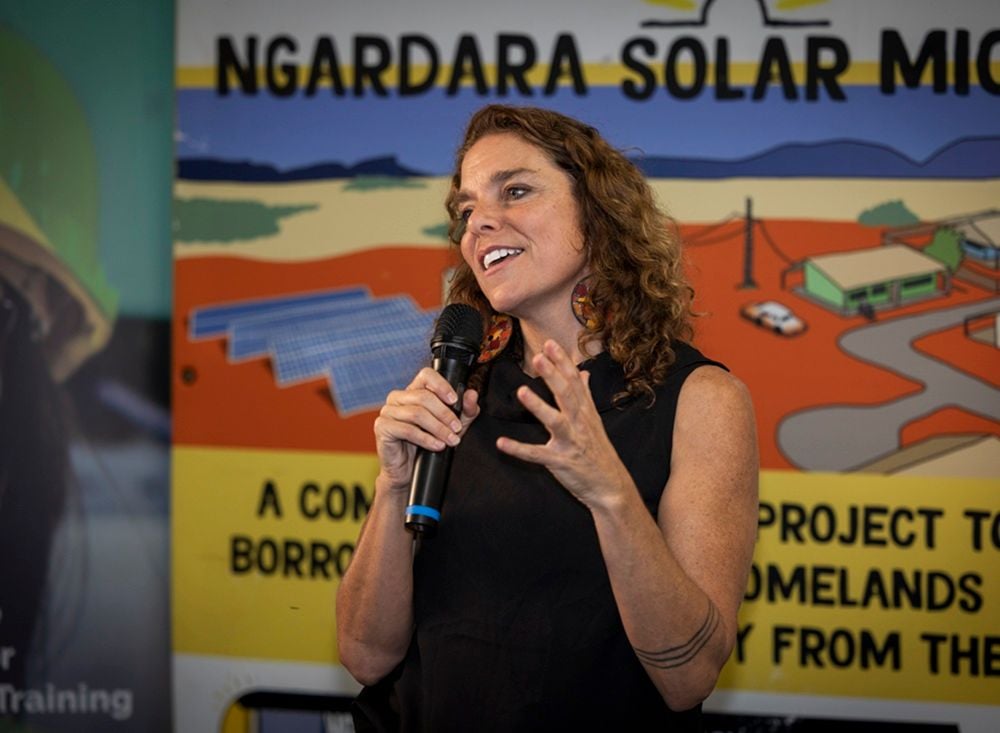
The Ngardara Project is co-led by Darwin-based First Nations clean energy organisation Original Power and the Ngardara Cooperative, a community-owned entity established specifically to develop and operate the microgrid.
The project comprises a 2.1 MW solar array and a 1.8 MW / 6.6 MWh battery energy storage system designed to achieve 80 per cent renewable energy penetration across the Borroloola township.
Borroloola's annual energy consumption is about 6.9 GWh, with diesel generation currently supplying around 87 per cent of the community's power.
The microgrid is projected to displace 1.2 million litres of diesel per year over its 25-year lifespan and deliver up to 50 per cent savings on electricity bills for households using prepayment meters.
“The Ngardara Solar Microgrid project directly challenges legacy energy systems to innovate and evolve to the emerging reality that First Nations communities are seeking to drive renewable energy solutions that can overcome long-term challenges to energy access and affordability," says Original Power co-director Madison Sturgess.
“Despite underdeveloped regulatory frameworks and traditionally monopolistic energy arrangements, the Ngardara Solar Microgrid project has driven the Northern Territory energy sector to co-deliver a viable blueprint for genuine ownership and benefit of local energy futures - the democratisation of energy for communities historically excluded from the renewables transition.”
Financial close for the Ngardara Project is targeted by mid-2026, with construction expected to commence in September 2026. Both projects remain subject to conditions before progressing to the construction phase.
ARENA CEO Darren Miller says the two projects will demonstrate how community-led clean energy models can work in some of Australia's most remote settings.
“These projects show the opportunities for First Nations-led design and co-development of local energy solutions, improving reliability, lowering costs and reducing reliance on diesel,” says Miller.
“Just as importantly, they help de-risk future community microgrid projects by generating practical learnings that other communities can draw on as they plan their own energy solutions.”
The $125 million Regional Microgrid Program has earmarked $75 million specifically for First Nations communities, reflecting the disproportionate reliance on diesel-powered generation in remote Indigenous townships.
AAAC CEO Ellie Kamara says power reliability is not an abstract concern for Ltyentye Apurte residents.
“The Ltyentye Apurte community prides itself on meeting the challenges of the community, on being innovative, and doing everything possible to improve the lives of the people in the community," she says.
“One such challenge is electricity reliability; in the past few years blackouts have occurred for significant lengths of time, and there is no alternative if power is down in the community.
"In the extreme hot or cold our old people suffer from either no heat or air-con, and the store cannot open - impacting food security for the community."
The microgrid should alleviate this challenge enabling a constant source of electricity in the event of a blackout, Kamara says.
“Selling the energy back into the grid seeks to enable a contribution to the electricity for each household, and create the opportunity for someone from the community to upskill and help support the maintenance of the microgrid and other infrastructure around the community.
"This may appear small to an outsider, but every contribution towards a household, and each person employed in the community contributes to the overall economy and wellbeing of the community.”
Ngardara Cooperative chair Scott McDinny says the Borroloola community is ready to move forward.
“The Ngardara Solar Microgrid project shows when community-led solutions are enabled through the right policies, resourcing and partnerships, we can overcome decades-old challenges around the high cost of remote power generation, solve household disconnections and build genuine economic prosperity and independence for our regions," he says.
"With a workforce trained and ready to go, we’re looking forward to breaking ground on this visionary project in coming months.”
Original Power executive director Karrina Nolan says the projects demonstrate what is possible when First Nations communities are positioned as project owners rather than passive recipients of infrastructure.
“This project demonstrates the incredible capacity of our communities to implement solutions to our own challenges," says Nolan.
"The Ngardara Solar Microgrid project successfully showcases a model for access to cleaner, more affordable power for remote communities, with significant benefits back to households, government, retailers and utilities.”
The funding announcements come as the federal government pushes to accelerate renewable energy deployment across regional and remote Australia, where diesel freight costs and ageing grid infrastructure create some of the highest per-kilowatt-hour energy costs in the country.
)